
Soft Armor
On style, aging, and a garment older than fashion.

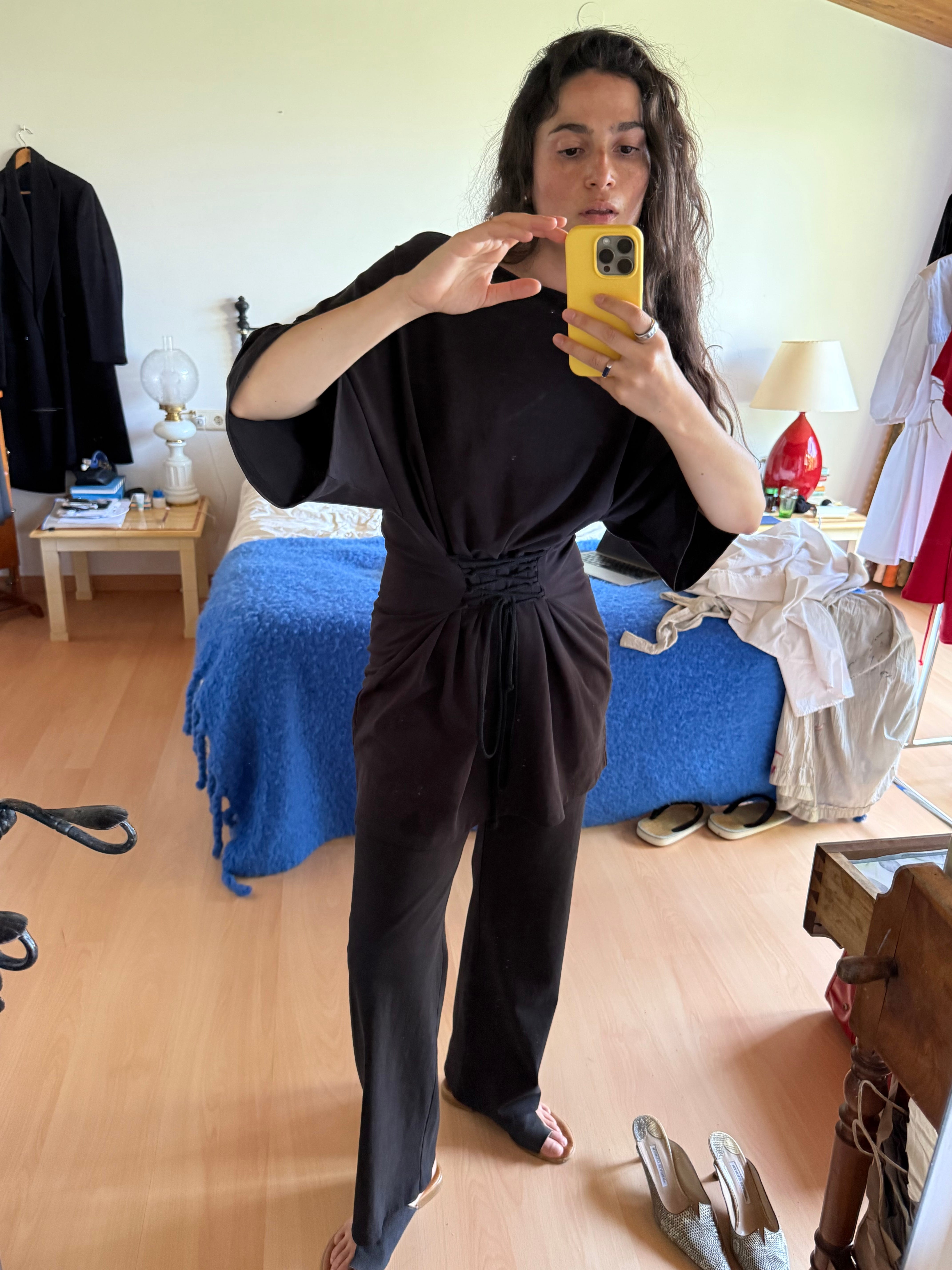
I’m on the daybed in my home studio. Film canisters and cameras strewn about, loose clothing tags printed with my last name in a slight font with colorful accents, a rolling rack of samples a colleague of Jordan’s generously muled here from LA, the clothes steamer underneath producing the familiar smell of overheated plastic and damp limescale buildup. I have been thinking a lot about tunics.
I wonder whether my deepening interest is a matter of fashion. Are tunics about to have a moment? I used to have a sense for these things. Or, whether I’m just aging. Staring at my messy office, I’m faced with contemplating my relevance and mortality at 36. In the past I’ve associated tunics with the matronly, even elderly, but lately they just feel…right. More than an elegant solution to discreetly cover an ass I used to deliberately put on display, they’re also uniquely versatile. A top, a dress, a beach cover up. Cinched at the waist or loose. Maybe I am old. Maybe it doesn’t matter. Does being on the pulse of what’s cool with the kids matter, as a maker of things? Will my customers age with me, or will I need to find young blood to mine for inspiration on how to dress for a life I no longer live?
This is what I think about when I think about tunics.
I believe a good closet is a toolkit, an organ of remedies built lovingly over time. Style emerges when you are no longer dressing to become someone — buying your way out of feelings of non-belonging — but to return to yourself. The trouble is that returning to myself, at 36, looks suspiciously like a tunic.
There is a version of this story — the easy one, the one the “industry” would prefer — where I am simply telling on myself. Admitting that my taste is contracting, the woman who once made cropped tops for women in their twenties is now making something looser for women her own age, and calling the contraction evolution because evolution sounds better. The slow fashion rhetoric runs on this kind of self-flattery. Aging is rebranded as discernment. Comfort is rebranded as luxury for “real” women with “real” lives. The tunic, in this story, is the (locally-knit-) cotton-clad coffin in which a woman buries her relevance and tells everyone the funeral is actually a baptism.
There is another version where I am doing the thing I have always done, which is pay attention to my own body and trust it to be a reasonable proxy for the bodies of the women I make clothes for. The tunic, in this story, is the next honest garment. It looks good with and without a postpartum stomach. It fluctuates and moves with a body that also fluctuates and moves. It doesn’t ask anything of the wearer. It is, possibly, what a thirty-six-year-old woman wants when she has finally stopped trying to look like she’s twenty-six. And if I’m right about this — if I’m still picking up the signal — then the women who have followed me here may be looking for the same thing.
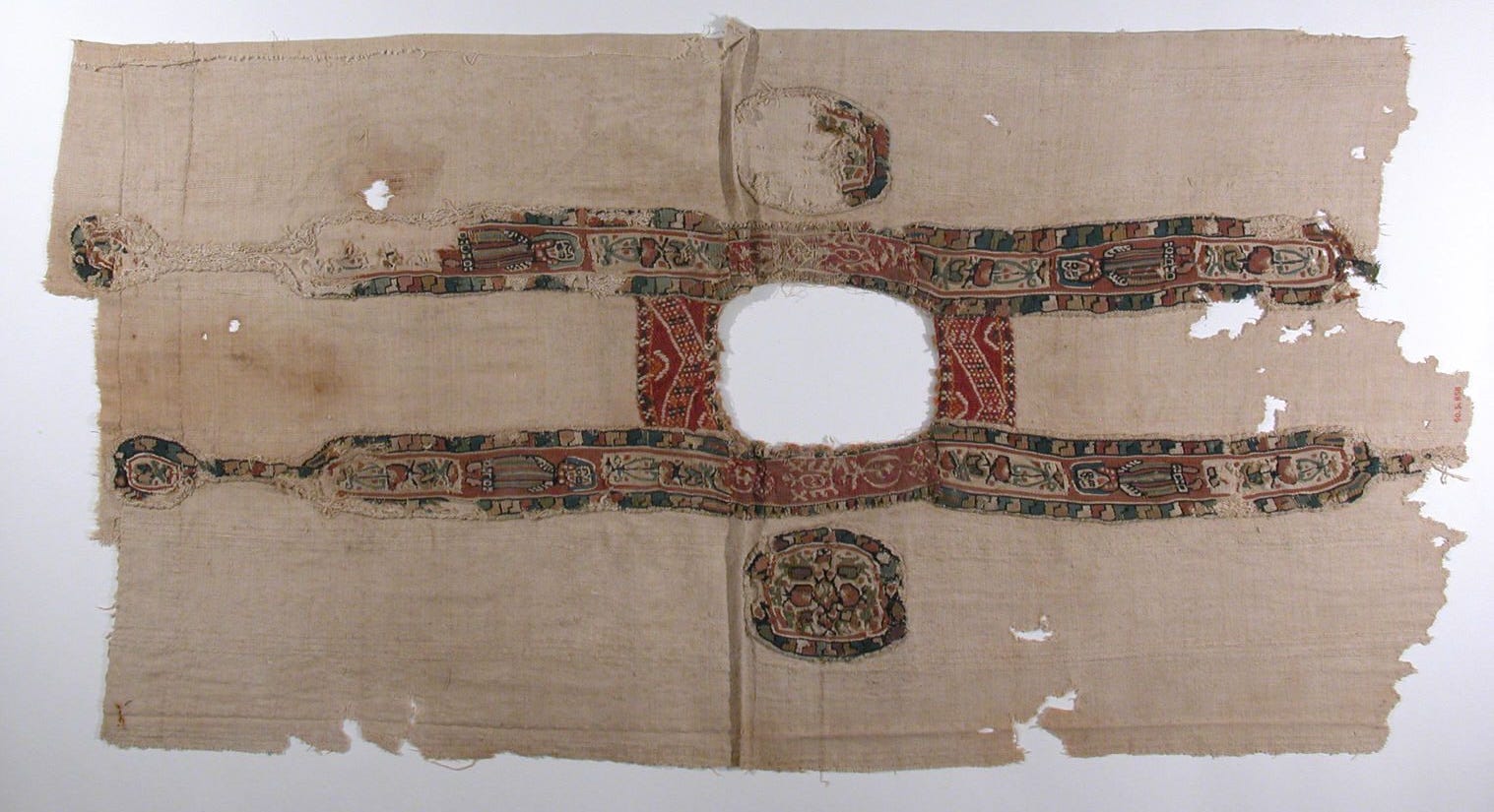
A tunic is older than the idea of fashion. Egyptian, Greek, Roman — for most of human history, in most places, the default garment was a piece of cloth with a hole for the head. Tailoring — clothes cut to follow the body, to reveal it on the body’s behalf — is, comparatively, a recent invention. The tunic predates the waistline as a concept worth enforcing. It’s what women wore before the body became a problem to be solved by clothes.
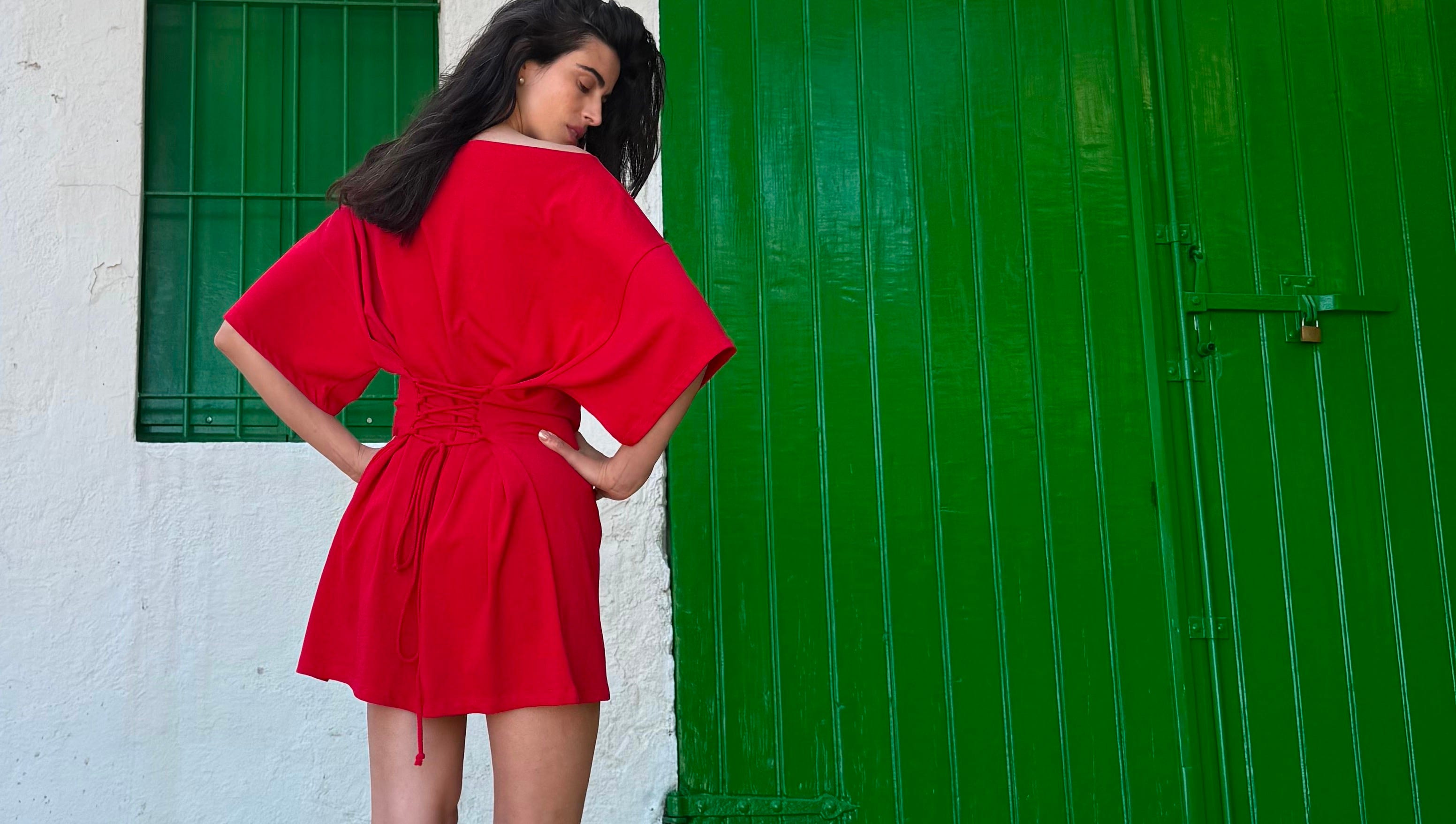
Except the tunics I made are not, exactly, the tunics I just described. One has a corded, corset-like waist that cinches, or doesn’t, and can be worn with this detail in the front or back. Another is slit all the way up the sides, open enough to show ribcage (and side-boob) if you move a certain way. They cover more than a cropped top and less than a caftan. They can be worn loose or pulled in, modest or not. I designed them this way without thinking too hard about it, and only afterward, looking at the rack, did I notice what I’d made and what it revealed. I’d refused to pick a side, and instead built a bridge.
I’m not sure if this is integrity or indecision. And also I’m not sure there’s a meaningful difference. What I know is that the woman who designed these tunics is not the woman who has stopped explaining herself, and she is also not the woman she was at twenty-six. She is somewhere in between, and the clothes are honest about that — which may, in the end, be the only kind of honesty a garment can offer.
I shot the collection at my house on my friend Judit, who like me, is 36. She lives in a neighboring village, and in a turn of kismet, was already a longtime Gil Rodriguez customer. She even owns pieces from our 2018 debut. The first real friend I made here had been wearing my clothes for nearly eight years — probably more if you count my American Apparel years — before we ever sat down together. She put the tunic on and looked immediately like a woman wearing something that had been made for her. I watched her in it and thought: either I am right about this garment, or I am wrong about it in a way that flatters exactly the kind of woman I am now. The tunic looks good on Judit. The tunic looks good on me. I like to imagine that’s enough.
There are days when I’m sure I’m still building the brand I set out to build in my twenties, only a little slower and with more honesty about what it costs me. There are days when I suspect I am letting it shrink to fit me and where I’m at. The collection launching this week and next was made on the latter kind of day and the former kind, in roughly equal measure.
What I can tell you is that I no longer trust the question is this trend coming back to be separate from the question am I aging into this. And I no longer trust either question to be separate from the one underneath. What does it mean that the most honest thing I've made in years is also the oldest?
I suspect the assignment is to make the thing that feels right now but still carries the DNA of who I’ve always been. Things that, with any luck, I’ll still want to wear at 50 and 70. Maybe it’s the nail in my coffin. Either way, you can bury me in this tunic.
Thank you for sharing your words. I love how you write and how you're willing to share your process. I remember myself mourning my crop top era, as nothing better could come after that, only to discover that life's movement is one of constant change; some things remain and others fluctuate, evolve and soften. How beautiful it is to be able to embrace all of it and to live in the present -as much as our messed up minds allow for :)
Looooooooveeeeeeeee